While grabbing coffee at the office today, I started chatting with some of Arrowhead’s game-designers. We were talking about MOBAs and since I haven’t really played any of those, I asked them to describe the drafting process I had seen on the TV broadcasts of the recent world championships. I found it very fascinating how the two teams take turns not only drafting from the list of heroes, but also get to ban others so the other team can’t pick them. I think that mechanic is interesting on many levels, and after a brief period of talking about it I suddenly came up with a design for a card-game using some of the same concepts. Here are the rules: Continue reading Draft/Ban poker game
Category Archives: Game Design
Sci-Fi card-game concept
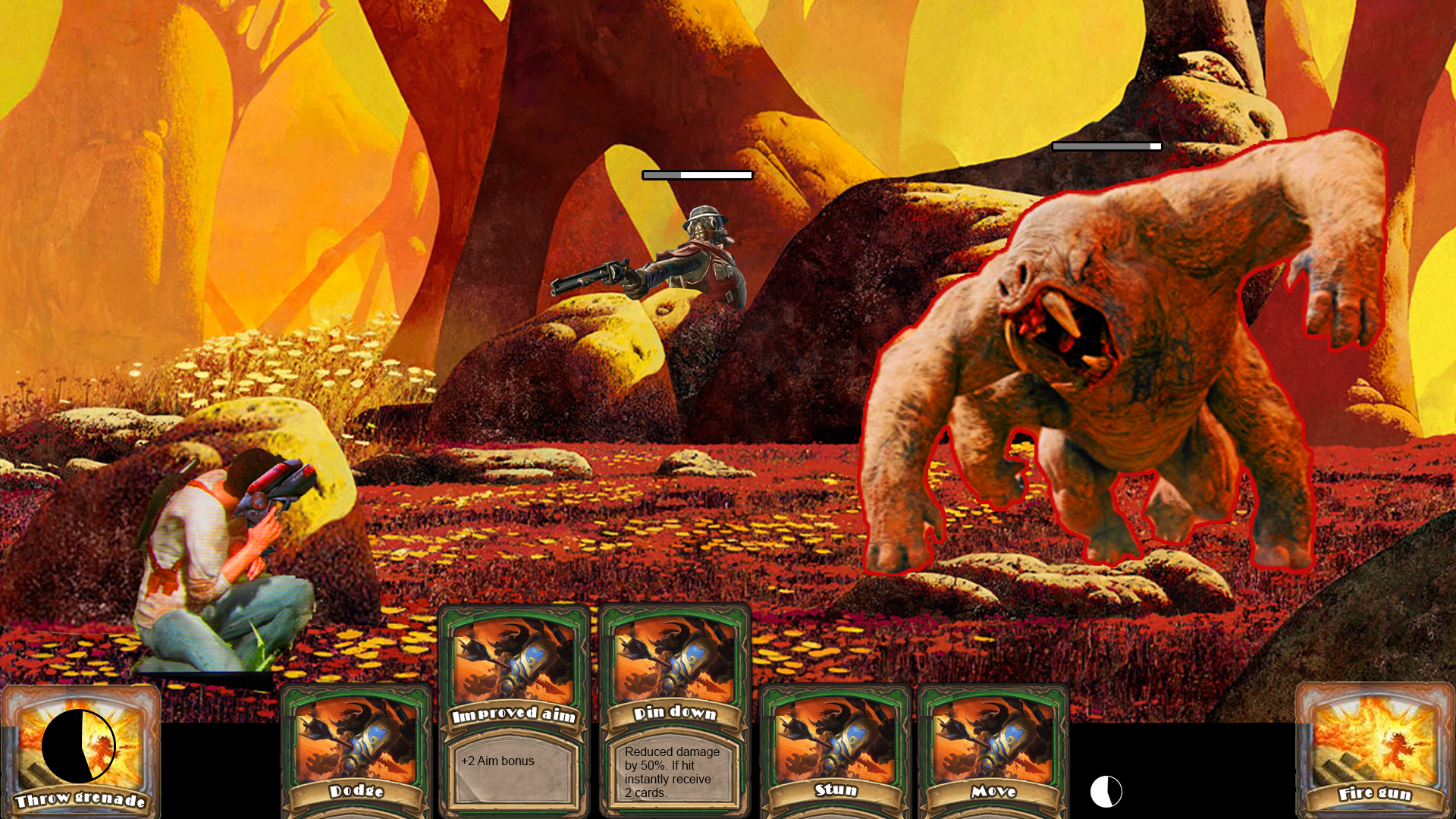 It always feels good when you spend a few hours getting that idea in your head down on “paper”. This is a concept of card-base adventure game with semi-realtime combat that I mocked up a few weeks ago.
Trading-card games as a mechanics for video-games seem to getting more popular every year. I’ve spent a bunch of time in the excellent Hearthstone recently and they nail so many things in that game. Blizzard being awesome as always.
Colors! 3D dev diary – What color are you?
The year is almost over, and Colors! 3D is not in your hands yet. This is due to the gallery integration feature. The term that Nintendo uses for features like the integrated gallery is “Rich User Generated Content”. This is not something we see too much of on consoles, so it’s been taking quite a while to work through.
Colors! 3D dev diary – latency, latency, latency
I’ve been told that I’m over-zealous about latency. Having spent more than 10 years working in the video-games industry as both an engineer and a designer, I’ve found latency to be one of easiest things to point out that differentiates a good experience from a bad one. It’s usually not easy to fix though.
Continue reading Colors! 3D dev diary – latency, latency, latency
Story reflection
LucasArts day 112. So, I never followed up on GDC. The weather was beautiful and I had a great time seeing some of my old friends. I only had chance to attend one day of sessions but that meant that I got to see industry-legend Hideo Kojima’s keynote about Metal Gear Solids evolution and Keita Takahashi’s heart-warming talk about Noby Noby Boy. But the session that gave me most was the Experimental Gameplay Sessions. Again, it’s clear that innovation within games is often not coming from the established developers. It almost seems like we are returning to the age of the bedroom coders with very few right and wrongs. Continue reading Story reflection
Countdown to IGF

LucasArts day 46. I’m starting to count down for Game Developers Conference. Even though I’ve been working in the game industry for over 10 years, I’ve never been there. I guess that having it across town makes it easier than it being 9 time-zones away. Today I got a mail from Nifflas, the maker of Knytt which is one of my favorite independent games, Continue reading Countdown to IGF
What can you really do in a week?

LucasArts day 36. Last December, LucasArts did something that to my knowledge other companies only dream of. They dedicated a full week for the whole company to go nuts with creating game prototypes. No matter if you were a hardcore programmer or if you were a part of the marketing department; for one week, you got to get your hands dirty and try out that idea that you previously only had been able to talk about over lunch. Continue reading What can you really do in a week?
Automated game testing
 Something that is very cumbersome (and boring) to do for every developer out there is the software testing. To combat that, you usually develop a number of methods that helps you track down bugs, for example automatic bug-reports and unit-testing.
One of the more interesting ones is automated testing. For games, this usually means that you have a system that simulates the player and automatically generates input for it. For my latest project Hyena. I’ve had the rare opportunity to play around with an application where the controls are so basic that it was actually possible to write a system that played the whole game for me.
2 cool indy-games
I just wanted to share two recent flash-game findings:
Rose & Camellia – A hilarious game which proves that any setting will work for any kind of game-play
Cursor * 10 – A brilliant innovative idea of a puzzle game
Totally brilliant.
(and on a similar note I just found out that Rorschach made 1up’s 101 Free Games 2008. Not too shabby)
Computergame + Human = Story
Yesterday I attended a lecture by Jonas Carlquist called “Datorspel + Människa = Berättelse” (Computergame + Human = Story). The lecture was mostly directed towards people who didn’t know that much about storytelling in games, but it was still very interesting to see everything from an academics point of view (also, he made a good impression on me by namedropping important games for storytelling like Deus Ex and Planescape Torment).
After thinking a bit about this lecture I though of some of the views I and my fellow designers at Starbreeze has had on how to tell stories in games. In the last couple of games we’ve made, storytelling has been extremely important.